
Shippers are Paying More Despite Shipping Less
According to the latest US Bank Freight Payment Index, Q2 shipment volumes were down 2.8% compared to the prior year. Despite this, freight spending was up by more than 28%, with US Bank pointing to tightening trucking capacity as the primary driver. The Cass Freight Index reflects a similar trend, with July shipment volumes down nearly 5% year over year while expenditures increased 9.1%.
The August Logistics Managers’ Index (LMI) tells a similar story and shows just how unusual current transportation conditions have become.
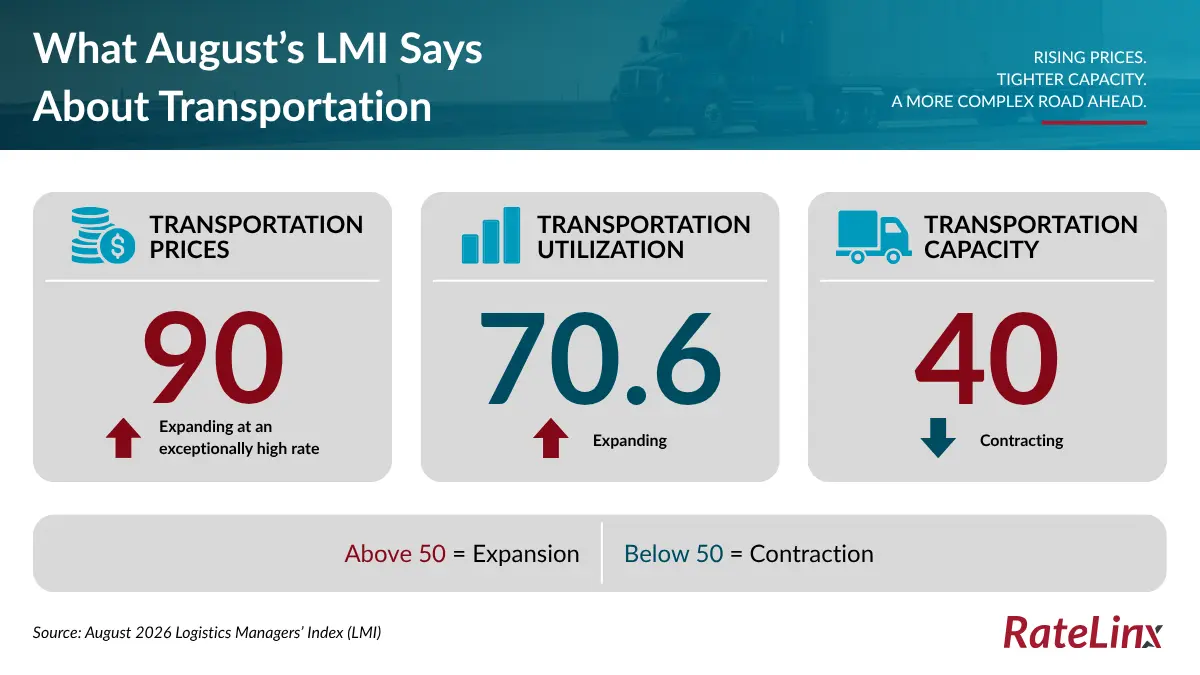
The LMI measures changes across key areas of the logistics industry on a scale where a reading above 50 indicates expansion and a reading below 50 indicates contraction. In August, Transportation Prices reached 90, meaning prices were expanding at an exceptionally high rate. This was the fourth time in five months that the index reached 90 or higher.
At the same time, Transportation Capacity registered just 40, marking the ninth consecutive month of contraction, while Transportation Utilization climbed to 70.6, its second-highest reading in two years.
Together, those numbers paint a clear picture: available transportation capacity remains tight while utilization and prices continue to rise.
Research from ACT Research provides additional context for what is driving that shift. ACT estimates that U.S. highway truckload capacity was 1.8% smaller year over year in August after roughly 20 months of contraction and points to shrinking capacity, rather than a broad surge in freight demand, as a primary driver of elevated freight rates.
Companies with logistics at the core of their operations probably did not need to see these statistics to know something has changed. They are already feeling it.
But there is a larger reality shippers need to consider: the freight market is shifting, and transportation strategies need to be able to shift with it.
You Cannot Control the Market; Only Your Response
Whether you are shipping a few hundred parcels a month or thousands of LTL shipments a week, rising market rates do not automatically mean every additional transportation dollar is unavoidable.
Shipment history, carrier performance, accessorial charges, service levels, contracted rates, freight invoices, and routing decisions all contain information that can reveal the opportunities for improvement.
The challenge is not necessarily collecting more data. Most organizations already have plenty of it. The challenge is turning that data into decisions that help answer the following questions:
- When was the last time you evaluated whether your contracted rates were still competitive?
- Do you know which accessorial charges are affecting your freight spend most?
- Are you routinely comparing expected transportation costs with what carriers actually invoice?
- Are shipments consistently moving with the best carrier and service level for the job?
The opportunity is not simply to collect more data. It is to connect the transportation data you already have and use it to identify where time and money may be getting lost.
Optimization Should Not Mean Disruption
Recognizing that your transportation strategy could perform better is one thing. Changing it is a whole other challenge that many organizations are hesitant to tackle.
Organizations evaluating logistics technology have legitimate concerns about:
- Implementation
- System Integration
- Data Security
- Historical Information
- Disruption to Daily Operations
Saving money is not particularly valuable if achieving it creates a different set of costly problems.
Instead of replacing technology for the sake of replacing it, start by asking what your business actually needs its logistics technology to accomplish.
Ask yourself if you can:
- See your complete transportation spend?
- Identify billing discrepancies and unnecessary charges?
- Evaluate carrier performance using your own shipment history?
- Adapt when market conditions change without rebuilding established workflows?
If not, the question becomes what is missing and how those capabilities can be added without compromising the stability of your existing operations.
Turning Insight Into Action
Knowing where transportation costs are increasing is useful. Being able to do something about it is what matters.
RateLinx connects transportation execution, visibility, freight audit and payment, analytics, and optimization within a single logistics platform. By connecting transportation data across an existing technology environment, shippers can better understand why problems are happening and where opportunities for improvement may exist.
That can mean comparing carriers and services before a shipment moves, comparing expected costs against actual carrier invoices to identify discrepancies or unexpected accessorials, and using historical shipment and carrier performance data to support contract negotiations.
Connected transportation data can reveal larger patterns, such as:
- Which carriers are performing as expected
- Where costs are trending upward
- Which lanes or locations may warrant attention
- Where changes to routing, procurement, or shipping processes could have the greatest impact
For organizations already using RateLinx, those opportunities may exist within data they are generating today. Speak with your Account Manager to review opportunities you may not be taking advantage of today.
For organizations evaluating their logistics technology, RateLinx is designed to integrate with existing technology environments, helping connect transportation data and expand logistics capabilities without sacrificing the stability and continuity required to keep shipments moving. Contact our Sales Team to explore where additional capabilities and potential savings may be within reach.
The freight market will continue to change. Rates will move. Capacity will expand and contract. New challenges will replace old ones.
The goal is not to predict every change. It is to build a logistics operation capable of responding when it happens.